Passer au menu principal

Chez Turkish Airlines, nous faisons en sorte que les passagères voyageant pendant leur grossesse aient une expérience de vol sereine. Nous prenons en compte tous les besoins des passagères enceintes et recommandons la lecture attentive des informations de voyage détaillées figurant sur cette page.

Voyage pendant la grossesse

Notre politique de vol pendant la grossesse prend à la fois en compte le stade de la grossesse et l'état de santé de la passagère. Pour les vols long courrier en particulier, même les passagères en bonne santé sont invitées à obtenir l'approbation de leur médecin.

Nous nous appuyons sur les renseignements fournis par la passagère concernant le stade de la grossesse. Pour cette raison, il est extrêmement important que nos passagères nous fournissent les informations correctes à ce sujet.

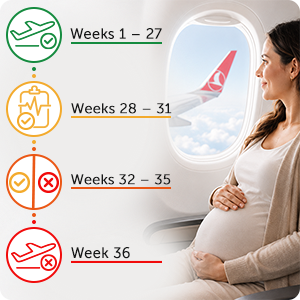
Les passagères qui n'ont pas encore entamé leur 28e semaine de grossesse sont en mesure de voyager sans certificat médical. Les femmes enceintes d'un seul enfant et qui se trouvent entre le début de la 28e semaine et la fin de la 35e semaine de grossesse peuvent voyager avec un certificat médical indiquant qu'il n'existe aucune raison particulière empêchant la patiente de voyager en avion. De même, le même certificat est nécessaire pour les femmes enceintes de plusieurs bébés et qui se trouvent entre le début de la 28e semaine et la fin de la 31e semaine de grossesse.

Indépendamment de tout certificat médical, nous n'autorisons pas à bord les femmes enceintes d'un seul bébé entrant dans leur 36e semaine de grossesse ou l'ayant dépassée, ni les femmes enceintes de plusieurs bébés entrant dans leur 32e semaine de grossesse ou l'ayant dépassée.

Règles de vol pendant la grossesse

Stade de la grossesse
1-27 semaines28-31 semaines32-35 semaines36 semaines et plus
Attendant 1 bébéEn mesure de volerCertificat médical requisCertificat médical requisNon en mesure de voler
Attendant plusieurs bébésNon en mesure de voler

Nos conseils pour voyager pendant la grossesse

  • Veuillez vous faire examiner par votre médecin et prendre note de tout conseil qui vous est ainsi fourni concernant les vols de longue durée.
  • Choisissez la Business Class pour les voyages transatlantiques. L'espace supplémentaire vous permettra de bouger les jambes plus facilement, éliminant ainsi le risque de problèmes de circulation sanguine.
  • Voyagez avec un compagnon et assurez-vous qu'il soit muni des coordonnées de votre médecin.
  • Pendant le vol, buvez beaucoup d'eau et évitez les boissons favorisant la déshydratation comme le thé et le café.
  • Marchez régulièrement à bord de l'avion, surtout pendant les vols de longue durée, ceci afin d'augmenter la circulation sanguine.
  • Pensez à choisir des sièges côté couloir lors de l'enregistrement, pour pouvoir vous rendre plus facilement aux toilettes.
  • Assurez-vous de vous munir de tous les certificats de votre médecin liés à votre santé. Si vous partez à l'étranger, assurez-vous que ces certificats soient en anglais. Avant de partir en voyage, prenez note des coordonnées du centre de soins le plus proche de l'endroit où vous séjournerez.
  • Pour réduire les effets du décalage horaire, évitez d'utiliser des somnifères.
Les passagères enceintes devant être munies d'un certificat médical pour voyager en avion doivent veiller à ce que ce certificat soit rédigé en turc ou en anglais et daté au plus tôt de sept jours avant la date du voyage. Le certificat doit être présenté sur le papier à en-tête du médecin ou de l'établissement médical. Il doit contenir les nom et prénom du médecin, son numéro de diplôme et sa signature ainsi que la date à laquelle il a été rédigé.

Flight clearance

Pregnant passengers’ eligibility to fly may vary depending on the number of weeks pregnant they are and their health condition. Even if a pregnant passenger is in good health, a doctor’s clearance is required, especially for long-haul flights. Since we rely on the information provided by passengers, it is extremely important that the information provided is accurate.

Week of pregnancy

Passengers with a single pregnancy may fly up to their 35th week of gestation with a doctor’s note stating “There are no medical contraindications for air travel.” The same medical certificate is required for passengers with a multiple pregnancy up to their 31st week of gestation. We cannot accept passengers with a single pregnancy who have a reached their 36th week of gestation, or passengers with a multiple pregnancy who have reached their 32nd week of gestation, even if they have a medical certificate.

Doctor’s note

Expectant mothers may travel without a doctor’s note up to their 28th week of gestation. Pregnant passengers who are required to present a doctor’s note for their flight must have obtained the note—prepared in Turkish or English—within 10 days prior to the flight date. The note must include the issuing doctor’s full name, license number, signature, and the date the note was issued.


Recommendations for pregnant passengers

  • Follow the advice provided by your doctor for long-haul flights.
  • On transoceanic flights, opt for Business Class to take advantage of the extra legroom. This allows you to move your limbs more comfortably and reduces the risk of circulation problems.
  • Travel with a companion and make sure your companion has your doctor’s contact information.
  • Drink plenty of water during flights, and avoid beverages such as tea and coffee that can cause fluid loss.
  • On long flights, walk around the cabin at regular intervals to improve blood circulation.
  • Select aisle seats or seats closer to the aisle for easier access to the restroom.
  • Carry medical reports detailing your health condition with you; for international trips, have these reports prepared in English. Before departing, determine the contact information for the healthcare facilities closest to your destination.
  • Avoid using sleeping pills to manage the effects of jet lag.

Hamile yolcu hakkında sıkça sorulan sorular

What happens if there is a risk of premature birth on a flight? View the answer

Starting from their 28th week of pregnancy, expectant mothers are accepted for travel if they present a doctor’s note stating “There are no medical contraindications for air travel.” However, unexpected situations may arise during the flight, and there may be a risk of premature birth. If the pregnant passenger does not feel well during the flight or experiences signs of premature labor, it is important to notify the cabin crew immediately.

Are special meals or in-flight meals provided to pregnant passengers during the flight? View the answer

During the flight, we offer pregnant passengers the standard in-flight meal service, which includes a variety of hot meals, snacks, and non-alcoholic beverage options. Pregnant passengers who have specific dietary requirements may request special meals, such as low-sodium or vegetarian options. Requests can be submitted during the booking process or up to 24 hours before the flight via the Turkish Airlines website or mobile app. Pregnant passengers who do not feel well during the flight or who prefer lighter meals can inform the cabin crew and ask for assistance with suitable alternatives, such as water or herbal tea.

How soon after birth can mothers and their newborns fly? View the answer

The eligibility of mothers and newborns to fly may vary depending on the health status of both the mother and the baby, as well as the doctor’s assessment. Newborns who are less than 48 hours old are not accepted on our flights. Infants aged 2–7 days are accepted for travel if a doctor’s note stating “Fit to travel by air” is provided. Infant passengers may travel only when accompanied by an adult, held on the adult’s lap, and secured with a special infant safety harness. The accompanying adult must be at least 18 years old; each adult may accompany only one infant. Infant passengers must have their own travel documents (passport, ID, ticket, etc.). For more information, please visit our infant passenger page.

Does undergoing airport security screening (X-ray/metal detector) during pregnancy harm the baby? View the answer

Metal detectors and body scanners used for passengers at airports emit very low levels of electromagnetic fields in accordance with international standards and are generally considered safe for pregnant passengers. While there is no evidence that passing through these devices once or for a short period of time harms the baby, you can also inform security personnel of your condition and request an alternative screening method, such as a manual search.

Is a doctor’s note required to travel while pregnant? View the answer

Passengers who have reached their 27th week of pregnancy must obtain a doctor’s note stating that there are no medical contraindications for air travel. Passengers within their first 26 weeks of pregnancy may travel without a doctor’s note.

Are passengers with a multiple pregnancy permitted to fly? View the answer

Passengers who are between 28–31 weeks pregnant with a multiple pregnancy must provide a doctor’s note stating “There are no medical contraindications for air travel.” We cannot accept passengers with a multiple pregnancy who have reached their 32nd week, even if they present a doctor’s note.

What are the requirements for the medical certificate needed by pregnant passengers for travel? View the answer

Pregnant passengers who require a medical certificate for their flight must have obtained the certificate—prepared in Turkish or English—within 10 days prior to the flight date. The certificate must include the issuing doctor’s full name, license number, signature, and the date the certificate was issued.