Saltar al contenido principal

En Turkish Airlines, nuestro objetivo es garantizar que las mujeres que viajen durante el embarazo disfruten de una experiencia de vuelo sin problemas. Tenemos en cuenta todas las necesidades de las mujeres que viajan durante el embarazo, por lo que le recomendamos que lea detenidamente la información de viaje que se detalla en esta página.

Viajar durante el embarazo

Nuestra política sobre los vuelos durante el embarazo depende de la etapa del embarazo de la pasajera y de su estado de salud. Todas las pasajeras embarazadas, incluso las que presentan un buen estado de salud, deben obtener la aprobación de su médico, especialmente si el vuelo es de larga duración.

Confiamos en la información proporcionada por la pasajera relativa a la etapa de su embarazo. Por esta razón, es muy importante que nuestras pasajeras nos proporcionen la información correcta.

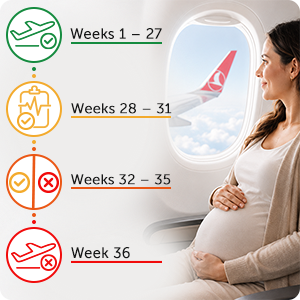
Las pasajeras que aún no hayan comenzado la semana 28 del embarazo pueden viajar sin certificado médico. Las pasajeras que estén esperando un bebé y que se encuentren entre el comienzo de la semana 28 y el final de la semana 35 del embarazo podrán viajar con un certificado médico que especifique que no existe ninguna razón particular por la que no puedan volar. Asimismo, se necesitará el mismo tipo de certificado anterior para las pasajeras que estén esperando más de un bebé y que se encuentren entre el comienzo de la semana 28 y el final de la semana 31 del embarazo.

Con independencia del certificado médico, no permitimos a bordo pasajeras que esperen un bebé y que comiencen o hayan superado la semana 36 del embarazo ni pasajeras que esperen más de un bebé y que comiencen o hayan superado la semana 32 del embarazo.

Reglas para volar durante el embarazo

Etapa del embarazo
1–27 semanas28–31 semanas32–35 semanas36 semanas o más
Embarazo de un bebéPuede volar.Necesita certificado médico.Necesita certificado médico.No puede volar.
Embarazo de más de un bebéNo puede volar.

Nuestros consejos para los viajes durante el embarazo

  • Visite a su médico para realizar un examen y tome buena nota de cualquier consejo relacionado con los vuelos de larga duración.
  • Elija la clase Business para los viajes transatlánticos. Gracias al espacio adicional para las piernas, podrá mover las piernas con más facilidad y evitará tener problemas circulatorios.
  • Viaje con un acompañante y asegúrese de llevar los datos de contacto de su médico.
  • Beba mucha agua y evite las bebidas que deshidratan, como el té y el café, durante el vuelo.
  • Pasee con regularidad en el avión, a fin de aumentar la circulación, especialmente en los vuelos de larga duración.
  • Recuerde seleccionar asientos de pasillo durante el check-in, ya que le resultará más sencillo ir al baño.
  • Asegúrese de llevar todas las notas médicas relacionadas con su estado de salud. Si viaja al extranjero, asegúrese de que estas notas estén en inglés. Antes de comenzar su viaje, elabore una nota con los datos de contacto del centro de salud más próximo al lugar donde vaya a alojarse.
  • Evite el uso de pastillas para dormir a fin de reducir los efectos del jetlag.
Las embarazadas que necesiten aportar un certificado médico para poder volar deben asegurarse de que el certificado esté redactado en turco o en inglés, y de que se haya emitido, como muy pronto, siete días antes de la fecha del viaje. El certificado debe llevar el membrete del médico o del centro de salud. Debe contener el nombre, apellidos, número de colegiado y firma del médico, junto con la fecha en que se redactó.

Flight clearance

Pregnant passengers’ eligibility to fly may vary depending on the number of weeks pregnant they are and their health condition. Even if a pregnant passenger is in good health, a doctor’s clearance is required, especially for long-haul flights. Since we rely on the information provided by passengers, it is extremely important that the information provided is accurate.

Week of pregnancy

Passengers with a single pregnancy may fly up to their 35th week of gestation with a doctor’s note stating “There are no medical contraindications for air travel.” The same medical certificate is required for passengers with a multiple pregnancy up to their 31st week of gestation. We cannot accept passengers with a single pregnancy who have a reached their 36th week of gestation, or passengers with a multiple pregnancy who have reached their 32nd week of gestation, even if they have a medical certificate.

Doctor’s note

Expectant mothers may travel without a doctor’s note up to their 28th week of gestation. Pregnant passengers who are required to present a doctor’s note for their flight must have obtained the note—prepared in Turkish or English—within 10 days prior to the flight date. The note must include the issuing doctor’s full name, license number, signature, and the date the note was issued.


Recommendations for pregnant passengers

  • Follow the advice provided by your doctor for long-haul flights.
  • On transoceanic flights, opt for Business Class to take advantage of the extra legroom. This allows you to move your limbs more comfortably and reduces the risk of circulation problems.
  • Travel with a companion and make sure your companion has your doctor’s contact information.
  • Drink plenty of water during flights, and avoid beverages such as tea and coffee that can cause fluid loss.
  • On long flights, walk around the cabin at regular intervals to improve blood circulation.
  • Select aisle seats or seats closer to the aisle for easier access to the restroom.
  • Carry medical reports detailing your health condition with you; for international trips, have these reports prepared in English. Before departing, determine the contact information for the healthcare facilities closest to your destination.
  • Avoid using sleeping pills to manage the effects of jet lag.

Hamile yolcu hakkında sıkça sorulan sorular

What happens if there is a risk of premature birth on a flight? View the answer

Starting from their 28th week of pregnancy, expectant mothers are accepted for travel if they present a doctor’s note stating “There are no medical contraindications for air travel.” However, unexpected situations may arise during the flight, and there may be a risk of premature birth. If the pregnant passenger does not feel well during the flight or experiences signs of premature labor, it is important to notify the cabin crew immediately.

Are special meals or in-flight meals provided to pregnant passengers during the flight? View the answer

During the flight, we offer pregnant passengers the standard in-flight meal service, which includes a variety of hot meals, snacks, and non-alcoholic beverage options. Pregnant passengers who have specific dietary requirements may request special meals, such as low-sodium or vegetarian options. Requests can be submitted during the booking process or up to 24 hours before the flight via the Turkish Airlines website or mobile app. Pregnant passengers who do not feel well during the flight or who prefer lighter meals can inform the cabin crew and ask for assistance with suitable alternatives, such as water or herbal tea.

How soon after birth can mothers and their newborns fly? View the answer

The eligibility of mothers and newborns to fly may vary depending on the health status of both the mother and the baby, as well as the doctor’s assessment. Newborns who are less than 48 hours old are not accepted on our flights. Infants aged 2–7 days are accepted for travel if a doctor’s note stating “Fit to travel by air” is provided. Infant passengers may travel only when accompanied by an adult, held on the adult’s lap, and secured with a special infant safety harness. The accompanying adult must be at least 18 years old; each adult may accompany only one infant. Infant passengers must have their own travel documents (passport, ID, ticket, etc.). For more information, please visit our infant passenger page.

Does undergoing airport security screening (X-ray/metal detector) during pregnancy harm the baby? View the answer

Metal detectors and body scanners used for passengers at airports emit very low levels of electromagnetic fields in accordance with international standards and are generally considered safe for pregnant passengers. While there is no evidence that passing through these devices once or for a short period of time harms the baby, you can also inform security personnel of your condition and request an alternative screening method, such as a manual search.

Is a doctor’s note required to travel while pregnant? View the answer

Passengers who have reached their 27th week of pregnancy must obtain a doctor’s note stating that there are no medical contraindications for air travel. Passengers within their first 26 weeks of pregnancy may travel without a doctor’s note.

Are passengers with a multiple pregnancy permitted to fly? View the answer

Passengers who are between 28–31 weeks pregnant with a multiple pregnancy must provide a doctor’s note stating “There are no medical contraindications for air travel.” We cannot accept passengers with a multiple pregnancy who have reached their 32nd week, even if they present a doctor’s note.

What are the requirements for the medical certificate needed by pregnant passengers for travel? View the answer

Pregnant passengers who require a medical certificate for their flight must have obtained the certificate—prepared in Turkish or English—within 10 days prior to the flight date. The certificate must include the issuing doctor’s full name, license number, signature, and the date the certificate was issued.