

- BOOK&MANAGE BOOKMANAGEADDITIONAL SERVICES
- EXPERIENCE CABIN CLASSESFLIGHT EXPERIENCEMORE
- DEALS&DESTINATIONS
- MILES&SMILES PROGRAM CONTENTEARN MILESREDEEM MILES
- HELP TRAVEL INFOFAQHELP CENTER
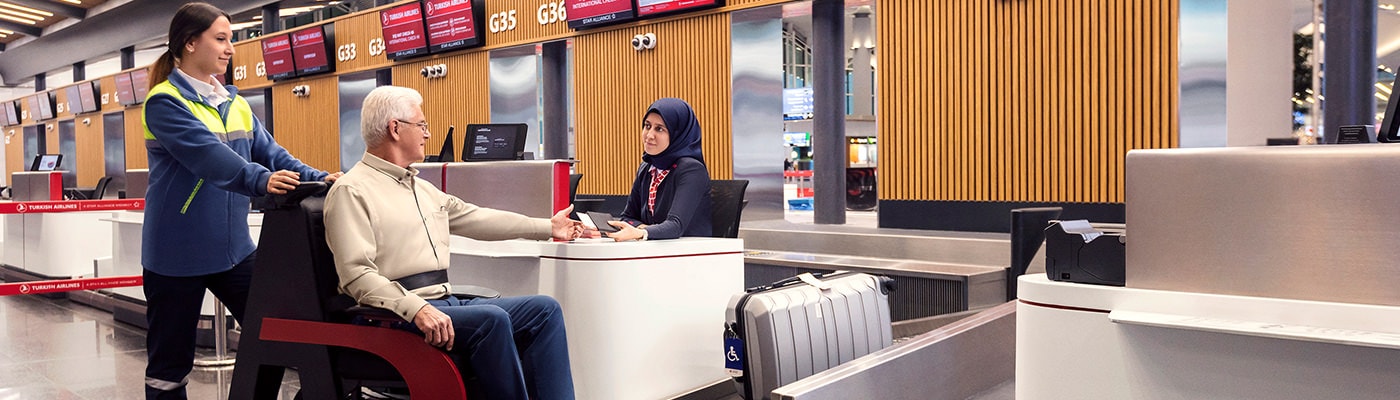
We provide wheelchair assistance to passengers in need, based on their requests. To benefit from wheelchair assistance, your request must be submitted at least 48 hours prior to the scheduled flight time and confirmed in your booking record. Requests made less than 48 hours before the flight will be accommodated as much as possible based on availability; however, the provision of this service may not be guaranteed.
To ensure timely completion of baggage, wheelchair assistance, and security procedures at the airport, we recommend that passengers with medical conditions or disabilities, whether they have completed online check-in or not, arrive at the terminal:
- At least 2 hours prior to domestic flights,
- At least 3 hours prior to international flights.
Passengers traveling with a stretcher are required to travel with a companion. The companion’s ticket is issued separately. Additionally, passengers needing to travel with a stretcher must provide a medical report in Turkish or English confirming their fitness to fly. This report must be issued no more than 10 days prior to the flight date.
Tickets for passengers traveling with a stretcher are issued for a fee determined by our airline. To benefit from this service, it is important to submit your requests at least 48 hours prior to the flight date.
We provide sign language services for our hearing-impaired passengers through our video call center. For detailed information and to submit your requests, click here.
At Istanbul Airport, passengers with disabilities or limited mobility can easily complete their check-in procedures by visiting the counters listed below:
If you have any concerns regarding your health before your flight, we strongly recommend consulting a doctor to ensure your journey is safe and comfortable. Most medical conditions do not prevent air travel; however, additional evaluations may be required in certain cases.
Passengers who have medical conditions that could be exacerbated or adversely affected by flying may be required to provide a doctor’s note stating that they “can complete the flight without needing urgent medical assistance.”
Passengers with disabilities or health issues are accepted for travel unless they fall into one of the following categories, or unless the airline’s procedures specify otherwise.
To ensure that they can safely complete their journey and follow safety instructions in an emergency, some passengers may need to fly with an attendant.
Whether a passenger requires an attendant can be assessed based on their ability to provide consistent and context-appropriate answers to questions, follow instructions, and independently complete check-in procedures.
In addition, if the passenger’s medical certificate or evaluation indicates the need for an attendant, the passenger is permitted to board only if accompanied by their attendant. For passengers who have medical conditions that require being accompanied on the flight by a healthcare professional (such as a doctor, paramedic, or nurse, as specified in the report) during the flight, that person must meet the criteria below.
Cabin crew members do not provide companion services for passengers.
Passengers with neurodevelopmental diversity (e.g., autism, ADHD (attention-deficit/hyperactivity disorder), intellectual or learning disabilities) are not required to provide a medical certificate; however, if these passengers require additional support in understanding safety instructions, responding appropriately to emergencies, or managing sensory challenges, they must travel with a companion.
Individuals in these situations may exhibit different behaviors—such as impulsivity, inattention, or an inability to sit still for long periods—due to social communication differences or stresses triggered by factors like light, sound, smell, crowds, or changes in environment. Passengers should not be asked questions regarding illness, medical diagnoses, etc., and they are not required to present a medical certificate.
However, if these passengers are traveling without a companion, their facility to understand safety instructions, to respond appropriately to emergencies, and/or to manage sensory difficulties can be assessed during the check-in process as follows:
Passengers with disabilities or reduced mobility can travel alone if they are able to meet their personal needs independently.
Passengers who are unable to understand safety instructions, respond appropriately to emergencies, manage sensory challenges, or meet their personal needs independently are required to travel with a companion.
To ensure that passengers who require a medical clearance can travel safely and comfortably on our flights, a medical certificate must be presented. The medical certificate, prepared in Turkish or English, must be completed by a doctor, must be dated within 10 days of the flight departure, and must include a written statement confirming that the passenger can complete the flight without needing urgent medical assistance.
The medical certificate must also include the doctor’s first and last name, title, license number, wet signature or e-signature, and the date of issue.

A complimentary wheelchair service is available to passengers with approved wheelchair requests. Wheelchair requests must be submitted at least 48 hours prior to the flight. Other wheelchair requests are evaluated within the station facilities.

We offer priority to special needs passengers upon request, and when checking in, going through passport control, and boarding. We provide special needs passengers withpreferred seat based on seat availability and aircraft configuration.

Guide dogs are accepted in the cabin free of charge. Reservations for emotional support dogs and guide dogs can be submitted up to 48 hours before departure. During the flight, guide dogs must sit at the feet of their owners, uncaged.
Guide dogs must have valid health certificates, identification documents and vaccination papers. In addition, guide dogs must have any other documentation required by the destination country. These documents may be requested when checking in.
For more information, please see our pet travel page.

Differences that are hard to spot by observing, such as dementia (forgetfulness), anxiety disorder, speech difficulties, reading difficulties, and vision difficulties, can cause individuals to have a hard time during their travels as well as in the airport and while flying.
In order to minimize these difficulties that may be experienced by our passengers during their travels, we have started to use the Sunflower Lanyard service.
When our ground services personnel and cabin crew members see a passenger wearing the sunflower lanyard, they will recognize that the passenger who wears the lanyard may need more help, support or more time in certain processes.
Passengers can obtain their lanyard free of charge from our Assisted Check in Counter at Istanbul Airport, without the need to prove their condition, and can use it throughout their travels. In addition, passengers can continue to use the same card on their upcoming trips and at points where the Sunflower lanyard is valid.

Some of the medical equipment you might need during the flight is available in our cabins. You may also use your own medical equipment during the flight.

For security reasons you are not allowed to use your own oxygen tank during the flight; however, we will provide oxygen tank with a medical certificate with the amount per minute stated on your medical report. The oxygen inquiries should be placed at least 48 hours before the flight.

In case you are traveling with personal respirator/ POC/CPAP machine please make sure that the device is FAA approved. You may use your own devices whenever you need to, except during take-off and landing. Passengers traveling with portable respirators must inform the reservation unit 48 hours before the flight time regarding the transportation and/or use of the devices. A doctor’s certificate is required if the passenger intends to use the portable respirator in the cabin. Please keep in mind that if you intend to use your inhaler on board, you should bring enough batteries (enough to last one and a half times the flight duration). There is no requirement to have a power outlet in the cabin for these devices.

Our passengers with diabetes may take their relevant medications without producing a report. Our passengers with medical conditions other than diabetes who are required to take medication during the flight must keep their prescriptions with them.
During flights to/from the United States, passengers may request to speak to a Complaint Resolution Official (CRO) regarding any problems related to a disability. The CRO team is authorized to resolve complaints on behalf of Turkish Airlines. CRO team members have undergone sensitivity and awareness training, as well as related DOT regulation and legislation training as specified in the “U.S Department of Transportation, Title 14, Chapter II, Sub-chapter D, Part 328, Subpart K”. CROs are available at the airports during operation hours. If you are not able to contact a CRO, you can e-mail CRO@THY.COM so that your issue gets the necessary attention. Please see this page for the complete list of CROs. CRO services are available in English and Turkish.
If you believe Turkish Airlines has violated any provision of the Code of Federal Regulations 14CFR, Part 382, you may file a formal complaint under the applicable procedures of 14CFR Part 382.65 via the following channels:
Via Mail:
U.S. Department of Transportation Aviation
Consumer Protection Division/C-75400
7th Street, SW
Washington, D.C. 20590
1-202-366-2220
Via online channel:
Aviation Consumer Protection Division >>
You can review the article "Non-discrimination on the Basis of Disability in Air Travel" title 14, chapter 2, section 382 under the Final Rule of the US Department of Transportation.
You can access the Department of Transportation's regulation via the following channels.
Free phone numbers for passengers with disabilities - in English:
1-800-778-4838 (voice)
1-800-455-9880 (TTY)
Phone numbers for the US Aviation Consumer Protection Department:
202-366-2220 (voice)
202-366-0511 (TTY)
Address of the US Aviation Consumer Protection Department:
C-75, U.S. Dept. of Transportation
1200 New Jersey Ave., SE.
Washington, D.C. 20590
Website of the US Aviation Consumer Protection:

 Special discount for our passengers with disability
Our passengers with disability, who are Miles&Smiles members benefit from a 20% discount in domestic flights and a 25% discount for international flights departing from Türkiye by submitting a “proof of disability” document only once.