
Visa-free travel to China!
Flights to China
Zurich (ZRH)to
Round-trip
Economy
Basel (BSL)to
Round-trip
Economy
Zurich (ZRH)to
Round-trip
Economy
Dublin (DUB)to
Round-trip
Economy
Dublin (DUB)to
Round-trip
Economy
Zurich (ZRH)to
Round-trip
Economy
Dublin (DUB)to
Round-trip
Economy
Geneva (GVA)to
Round-trip
Economy
Basel (BSL)to
Round-trip
Economy
Geneva (GVA)to
Round-trip
Economy
Basel (BSL)to
Round-trip
Economy
Geneva (GVA)to
Round-trip
Economy
What is the Visa-Free Policy?
China’s visa-free policy primarily includes two categories: visa exemption and transit visa exemption. Visa Exemption: This allows travelers to enter China directly without a visa, based on bilateral or multilateral agreements, or unilateral rules set by China. Depending on the agreement, you can stay in a specified area for tourism, business, and other purposes.
Transit Visa Exemption: If you’re traveling through China to another destination, you can stay for up to 240 hours (10 days) without a visa, provided you have a valid travel document and a connecting ticket. This visa exemption applies only at certain ports and regions, allowing you to explore China during your layover without the hassle of applying for a full tourist visa.
China’s Visa-Free Policies in 2025
Countries Eligible for China’s Visa-Free Policy: |
|
| Asia- Pacific |
|
| Europe |
|
| North America |
|
| South America |
|
| Middle East |
|
|
The 240-hour visa-free transit policy allows travelers to transit through China and stay for up to 10 days without a visa, provided they meet specific criteria. This is a significant upgrade from the previous 144-hour visa-free policy, offering visitors more time to explore China’s diverse culture, history, and landscapes. *Information updated on May 13, 2025. For detailed information please visit the linked page. |
|
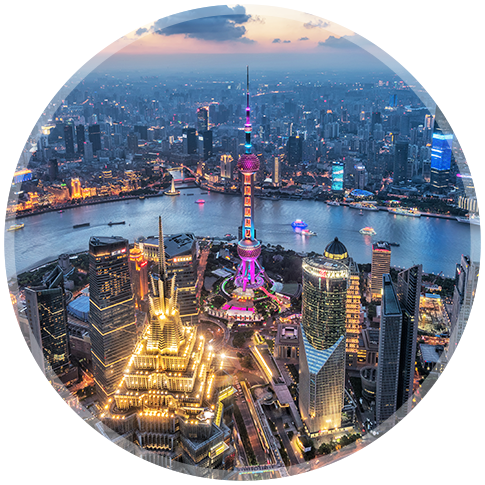
Shanghai
Shanghai is one of the most populous and developed cities in the country. A global center of finance, trade and transportation, Shanghai also stands out with its modern architecture and technological infrastructure. The Bund area along the Huangpu River is a symbolic area where historical buildings and modern skyscrapers are located side by side.

Beijing
Beijing, the capital of China, is at the heart of Chinese history and culture with thousands of years of history. Historical landmarks such as the Forbidden City, Tiananmen Square and the Great Wall of China are located in Beijing. Beijing is also home to important universities, government institutions and cultural events. The city has a rich mix of traditional Chinese architecture and modern buildings.
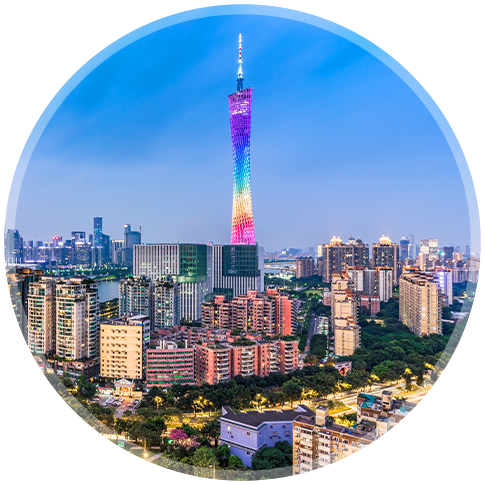
Guangzhou
Guangzhou is located in southern China, the capital of Guangdong Province. Guangzhou is one of the most important trade centers of China with its ports and industrial zones. It also stands out with its subtropical climate, diverse ethnic structure and rich cuisine.
Frequently asked questions about Visa-Free travel to China
Can I extend my 240-hour visa-free stay?; More information >>
No, extensions are not permitted. You must leave China before the 240-hour period ends.
What happens if I overstay?; More information >>
Overstaying can result in fines, detention, or being banned from re-entering China. In addition, the National Immigration Administration stated that travelers entering China under the visa-free transit policy who need to stay beyond the permitted duration or travel outside the designated areas due to urgent and reasonable reasons or force majeure must apply for a stay permit in advance at the local public security bureau’s entry-exit administration department.
Can I enter China from Guangzhou and exit from Shanghai, or can I enter from Shanghai and exit from Guangzhou?; More information >>
Both options are possible. The 240-hour visa-free transit policy allows travelers to travel between provinces.
I just apply for the 240 hour visa upon arrival in China?; More information >>
Yes, you apply for the 240-hour visa-free entry upon arrival in China at the airport. You don’t need to apply for it in advance; it’s granted at the immigration counter when you arrive. At the immigration counter, simply inform the officer that you’re applying for 240-hour visa-free transit and provide necessary documents. If everything is in order, you’ll receive the visa-free entry for the specified time period.
Is the 240-hour limit for “240-hour visa-free transit” calculated from the time of entry?; More information >>
No, the 240-hour limit is calculated starting from 00:00 on the day following the passenger’s entry. For example, if a passenger enters Guangzhou Baiyun International Airport at 08:00 on January 1, 2025, the visa-free transit period will start from 00:00 on January 2, 2025, and they must exit before 23:59 on January 11, 2025.
If a passenger plans to buy an outbound ticket after entry, can they apply for visa-free transit?; More information >>
According to the policy, to apply for the visa-free transit, passengers must hold a confirmed ticket with a set date and seat to a third country (region) before entering China. Therefore, if the connecting ticket has not been purchased in advance, the passenger cannot take advantage of this policy.
I’m a U.S. citizen flying to Guangzhou and have a train or ferry ticket to Hong Kong/Macau within 240 hours. Can I apply for the 240-hour visa-free transit?; More information >>
Yes, you can.
What is considered as “third region”?; More information >>
A “third region” is the next destination after China, different from your origin.
Is the layover country/region counts as a third country/region?; More information >>
The simplest way is to ask your airline to confirm how the route will be listed on your ticket. China’s entry border control determines your departure or destination country/region based on the last country/region you flew from to China. Generally speaking, if a passenger departs from one country and the flight stops in another country or region without going through immigration, the stopover location is not considered the departure or destination point.
Is Hong Kong / Macau considered as “third region” under the 240-hour visa-free transit policy?; More information >>
Yes, both Hong Kong and Macau are classified as “third region” under China’s 240-hour visa-free transit policy, meaning that travelers can plan itineraries that include these locations without needing to obtain a visa for mainland China, as long as they comply with the transit requirements. Therefore, you can take advantage of this by returning to your departure point/country from Hong Kong or Macau. For example: USA – China – USA: doesn’t work; USA – Hong Kong – China – USA: works; USA – China – Macau – USA: works too.
Can I apply for TWOV when entering mainland China from Hong Kong via railway?; More information >>
No, you can’t apply for TWOV when entering mainland China from Hong Kong via railway, cause there’s no eligible port available.
Can I use the 240-hour visa-free transit policy multiple times in a short period? Is there any required time gap between each use?; More information >>
Yes, there is no limit on the number of times you can use the policy, nor is there any required time gap between each use. For example, for a trip from the USA to Shanghai, Hong Kong, and Guangzhou, you can apply for the TWOV twice: once for USA – Shanghai – Hong Kong, and again for Hong Kong – Guangzhou – USA.
If I enter China under the 240-hour TWOV, can I change my outbound flight and time afterwards? Do I need to report it to anyone in advance?; More information >>
Yes, such changes are allowed as long as they occur within 240 hours and do not require prior reporting. You only need to explain the situation and provide relevant proof to the immigration officer on the day of departure to exit smoothly.
Is there an official number I can call to inquire?; More information >>
Yes, you can call the National Immigration Administration service platform at +86 12367 to ask. Multiple languages are supported.