Passa al contenuto principale

Noi di Turkish Airlines facciamo tutto il possibile affinché le passeggere in gravidanza possano godersi un'esperienza di volo senza alcun problema. Teniamo in grande considerazione le esigenze delle future mamme e consigliamo di leggere attentamente le informazioni di viaggio dettagliate contenute in questa pagina.

Viaggi in aereo durante la gravidanza

La nostra politica relativa al volo durante la gravidanza dipende sia dallo stato della gestazione che dalle condizioni di salute della passeggera. In particolare in occasione di lunghi voli, anche le passeggere in buono stato di salute devono ottenere l'approvazione da parte del proprio medico.

Facciamo affidamento sulle informazioni relative alla fase della gravidanza forniteci dalle passeggere: pertanto, è di fondamentale importanza che esse siano accurate.

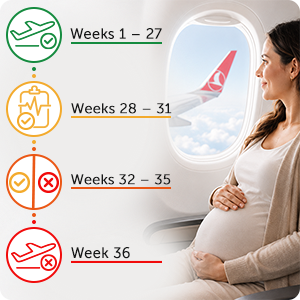
Le passeggere che non sono ancora entrate nella 28esima settimana di gravidanza possono viaggiare senza certificato medico. Le donne incinte in attesa di un solo bebè, nel periodo gestazionale compreso tra l'inizio della 28esima e la fine della 35esima settimana, potranno prendere l'aereo presentando un certificato medico attestante l'assenza di particolari ragioni che impediscano loro di volare. Analogamente, tale certificato è necessario per le passeggere incinte di più di 1 bebè, nel periodo gestazionale compreso tra l'inizio della 28esima e la fine della 31esima settimana.

Indipendentemente dalla presentazione del certificato medico, non ammettiamo a bordo passeggere in attesa di 1 bebè all'inizio della 36esima settimana di gravidanza o oltre, né passeggere in attesa di più di 1 bebè dall'inizio della 32esima settimana in poi.

Regole per viaggiare in aereo durante la gravidanza

Fase della gravidanza
1-27 settimane28-31 settimane32-35 settimane36 settimane o più
In attesa di 1 bebèAmmissione al voloCertificato medico obbligatorioCertificato medico obbligatorioInibizione al volo
In attesa di più di 1 bebèInibizione al volo

I nostri consigli per il viaggio durante la gravidanza

  • Si sottoponga a un controllo medico e presti particolare attenzione alle indicazioni relative ai voli di lunga durata.
  • Scelga la classe Business per i voli transatlantici. Avrà la possibilità di muovere maggiormente le gambe grazie allo spazio extra a disposizione, eliminando il rischio di problemi circolatori.
  • Viaggi con un accompagnatore e si assicuri che questi disponga dei recapiti per contattare il suo medico.
  • Durante il volo beva molta acqua ed eviti bevande disidratanti come tè e caffè.
  • Soprattutto in caso di lunghi viaggi, cammini di tanto in tanto all'interno del velivolo, per migliorare la circolazione sanguigna.
  • Si ricordi di scegliere posti adiacenti al corridoio quando effettua il check-in: in questo modo sarà più semplice recarsi alla toilette.
  • Porti sempre con sé tutti i certificati medici di cui dispone. Se viaggia all'estero, si assicuri che siano in inglese. Prima della partenza, annoti i dati di contatto della struttura sanitaria più vicina alla località della sua permanenza.
  • Eviti di prendere pastiglie per dormire, se vuole ridurre gli effetti del jetlag.
Le passeggere incinte tenute a presentare certificato medico per poter salire in aereo devono assicurarsi che tale certificato sia scritto in turco o in inglese, in data non superiore a 7 giorni prima del viaggio. Il certificato deve essere redatto su carta intestata del medico o della struttura sanitaria competente e deve riportare nome e cognome, numero di abilitazione e firma del medico, oltre alla data di emissione.

Flight clearance

Pregnant passengers’ eligibility to fly may vary depending on the number of weeks pregnant they are and their health condition. Even if a pregnant passenger is in good health, a doctor’s clearance is required, especially for long-haul flights. Since we rely on the information provided by passengers, it is extremely important that the information provided is accurate.

Week of pregnancy

Passengers with a single pregnancy may fly up to their 35th week of gestation with a doctor’s note stating “There are no medical contraindications for air travel.” The same medical certificate is required for passengers with a multiple pregnancy up to their 31st week of gestation. We cannot accept passengers with a single pregnancy who have a reached their 36th week of gestation, or passengers with a multiple pregnancy who have reached their 32nd week of gestation, even if they have a medical certificate.

Doctor’s note

Expectant mothers may travel without a doctor’s note up to their 28th week of gestation. Pregnant passengers who are required to present a doctor’s note for their flight must have obtained the note—prepared in Turkish or English—within 10 days prior to the flight date. The note must include the issuing doctor’s full name, license number, signature, and the date the note was issued.


Recommendations for pregnant passengers

  • Follow the advice provided by your doctor for long-haul flights.
  • On transoceanic flights, opt for Business Class to take advantage of the extra legroom. This allows you to move your limbs more comfortably and reduces the risk of circulation problems.
  • Travel with a companion and make sure your companion has your doctor’s contact information.
  • Drink plenty of water during flights, and avoid beverages such as tea and coffee that can cause fluid loss.
  • On long flights, walk around the cabin at regular intervals to improve blood circulation.
  • Select aisle seats or seats closer to the aisle for easier access to the restroom.
  • Carry medical reports detailing your health condition with you; for international trips, have these reports prepared in English. Before departing, determine the contact information for the healthcare facilities closest to your destination.
  • Avoid using sleeping pills to manage the effects of jet lag.

Hamile yolcu hakkında sıkça sorulan sorular

What happens if there is a risk of premature birth on a flight? View the answer

Starting from their 28th week of pregnancy, expectant mothers are accepted for travel if they present a doctor’s note stating “There are no medical contraindications for air travel.” However, unexpected situations may arise during the flight, and there may be a risk of premature birth. If the pregnant passenger does not feel well during the flight or experiences signs of premature labor, it is important to notify the cabin crew immediately.

Are special meals or in-flight meals provided to pregnant passengers during the flight? View the answer

During the flight, we offer pregnant passengers the standard in-flight meal service, which includes a variety of hot meals, snacks, and non-alcoholic beverage options. Pregnant passengers who have specific dietary requirements may request special meals, such as low-sodium or vegetarian options. Requests can be submitted during the booking process or up to 24 hours before the flight via the Turkish Airlines website or mobile app. Pregnant passengers who do not feel well during the flight or who prefer lighter meals can inform the cabin crew and ask for assistance with suitable alternatives, such as water or herbal tea.

How soon after birth can mothers and their newborns fly? View the answer

The eligibility of mothers and newborns to fly may vary depending on the health status of both the mother and the baby, as well as the doctor’s assessment. Newborns who are less than 48 hours old are not accepted on our flights. Infants aged 2–7 days are accepted for travel if a doctor’s note stating “Fit to travel by air” is provided. Infant passengers may travel only when accompanied by an adult, held on the adult’s lap, and secured with a special infant safety harness. The accompanying adult must be at least 18 years old; each adult may accompany only one infant. Infant passengers must have their own travel documents (passport, ID, ticket, etc.). For more information, please visit our infant passenger page.

Does undergoing airport security screening (X-ray/metal detector) during pregnancy harm the baby? View the answer

Metal detectors and body scanners used for passengers at airports emit very low levels of electromagnetic fields in accordance with international standards and are generally considered safe for pregnant passengers. While there is no evidence that passing through these devices once or for a short period of time harms the baby, you can also inform security personnel of your condition and request an alternative screening method, such as a manual search.

Is a doctor’s note required to travel while pregnant? View the answer

Passengers who have reached their 27th week of pregnancy must obtain a doctor’s note stating that there are no medical contraindications for air travel. Passengers within their first 26 weeks of pregnancy may travel without a doctor’s note.

Are passengers with a multiple pregnancy permitted to fly? View the answer

Passengers who are between 28–31 weeks pregnant with a multiple pregnancy must provide a doctor’s note stating “There are no medical contraindications for air travel.” We cannot accept passengers with a multiple pregnancy who have reached their 32nd week, even if they present a doctor’s note.

What are the requirements for the medical certificate needed by pregnant passengers for travel? View the answer

Pregnant passengers who require a medical certificate for their flight must have obtained the certificate—prepared in Turkish or English—within 10 days prior to the flight date. The certificate must include the issuing doctor’s full name, license number, signature, and the date the certificate was issued.