

- 予約と管理
- エクスペリエンス
- お得な情報と目的地
- Miles&Smiles プログラムの内容マイルを獲得マイルを交換
- ヘルプ
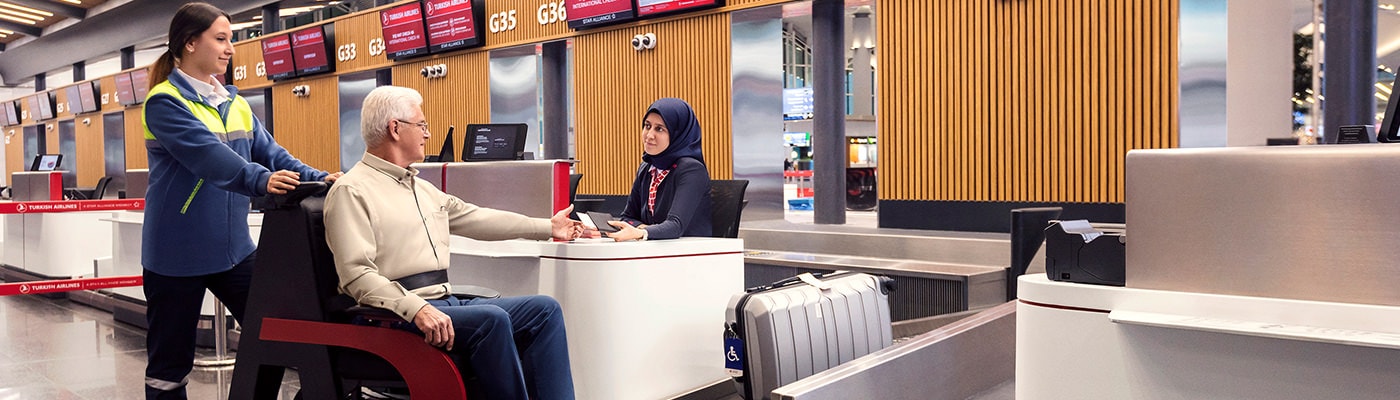
車椅子サービスが必要な場合は、フライト予定時刻の 48 時間前までにお申し出いただき、ご予約時にご確認ください。 48 時間前までにお申し出いただいたリクエストは、リソースの利用可能状況に基づいて検討される可能性がありますが、これらのリクエストに必ずしも対応できるとは限りません。 空港での手荷物の取り扱い、車椅子の対応、セキュリティ手続きをタイムリーに完了するために、オンラインチェックインを完了しているかどうかにかかわらず、医学的条件または障害のあるお客様は、国内線の場合は出発時間の少なくとも 2 時間前、国際線の場合は出発時間の少なくとも 3 時間前にターミナルに到着することをお勧めします。
ご旅行にストレッチャーが必要なお客様にはお付き添いの方が必要です。ご同伴のお客様のチケットは別途発行されます。 また、ストレッチャーでのご旅行を希望されるお客様と付き添いのお客様は、健康状態がフライトに適していることを示す報告書を、トルコ語と英語の両方でご用意していただく必要があります。 この報告書は、発行日から 10 日以内にご提出ください。 ストレッチャーでのご旅行が承認されたお客様には、当社が定めた運賃でチケットが発行されます。 ストレッチャーでのご旅行が許可されたお客様は、フライトの48時間前までに事前通知を行い、ご要望をお申し出ください。
弊社では、聴覚に障がいのあるお客様向けに、ビデオコールセンターを通じて手話サービスを提供しています。 詳しい情報について、およびリクエストを送信するには、こちらをクリックしてください。
イスタンブール空港では、お手伝いが必要なお客様や移動に制限のあるお客様は、以下のカウンターで簡単にチェックイン手続きを完了できます。
If you have any concerns regarding your health before your flight, we strongly recommend consulting a doctor to ensure your journey is safe and comfortable. Most medical conditions do not prevent air travel; however, additional evaluations may be required in certain cases.
Passengers who have medical conditions that could be exacerbated or adversely affected by flying may be required to provide a doctor’s note stating that they “can complete the flight without needing urgent medical assistance.”
Passengers with disabilities or health issues are accepted for travel unless they fall into one of the following categories, or unless the airline’s procedures specify otherwise.
To ensure that they can safely complete their journey and follow safety instructions in an emergency, some passengers may need to fly with an attendant.
Whether a passenger requires an attendant can be assessed based on their ability to provide consistent and context-appropriate answers to questions, follow instructions, and independently complete check-in procedures.
In addition, if the passenger’s medical certificate or evaluation indicates the need for an attendant, the passenger is permitted to board only if accompanied by their attendant. For passengers who have medical conditions that require being accompanied on the flight by a healthcare professional (such as a doctor, paramedic, or nurse, as specified in the report) during the flight, that person must meet the criteria below.
Cabin crew members do not provide companion services for passengers.
Passengers with neurodevelopmental diversity (e.g., autism, ADHD (attention-deficit/hyperactivity disorder), intellectual or learning disabilities) are not required to provide a medical certificate; however, if these passengers require additional support in understanding safety instructions, responding appropriately to emergencies, or managing sensory challenges, they must travel with a companion.
Individuals in these situations may exhibit different behaviors—such as impulsivity, inattention, or an inability to sit still for long periods—due to social communication differences or stresses triggered by factors like light, sound, smell, crowds, or changes in environment. Passengers should not be asked questions regarding illness, medical diagnoses, etc., and they are not required to present a medical certificate.
However, if these passengers are traveling without a companion, their facility to understand safety instructions, to respond appropriately to emergencies, and/or to manage sensory difficulties can be assessed during the check-in process as follows:
Passengers with disabilities or reduced mobility can travel alone if they are able to meet their personal needs independently.
Passengers who are unable to understand safety instructions, respond appropriately to emergencies, manage sensory challenges, or meet their personal needs independently are required to travel with a companion.
To ensure that passengers who require a medical clearance can travel safely and comfortably on our flights, a medical certificate must be presented. The medical certificate, prepared in Turkish or English, must be completed by a doctor, must be dated within 10 days of the flight departure, and must include a written statement confirming that the passenger can complete the flight without needing urgent medical assistance.
The medical certificate must also include the doctor’s first and last name, title, license number, wet signature or e-signature, and the date of issue.

承認済みの車椅子リクエストがあるお客様は、無料の車椅子サービスをご利用いただけます。 車椅子のご要望は、フライトの48時間前までにお申し出ください。 それ以外の車椅子リクエストは、空港施設内で精査されます。

ご要望に応じて、チェックイン時、出国審査時、搭乗時に、特別なニーズのあるお客様を優先します。 座席の空き状況と航空機の構成に基づいて、特別なニーズのあるお客さまに、前列の座席をご提供します。

盲導犬は無料で客室にお迎えいたします。 エモーショナルサポート犬と盲導犬のご予約は、ご出発の48時間前までお申し込みいただけます。 フライト中は、盲導犬はケージにいれず、飼い主の足元に座らせてください。
盲導犬には、有効な健康証明書、身分証明書、予防接種証明書が必要です。 さらに、盲導犬には目的地の国で必要とされる他の書類も必要です。 チェックイン時にこれらの書類が必要となる場合があります。
詳しい情報については、弊社のペットとのご旅行ページをご覧ください。

自閉症、認知症(物忘れ)、不安障害、言語障害、読字困難、視力障害など、観察しているだけではわかりにくい違いは、旅行中はもちろん、空港や飛行中にも本人が苦労する原因になることがあります。
お客様が移動中に感じるこのような困難を最小限にするために、「ひまわりストラップ」サービスを開始しました。
地上サービス担当者や客室乗務員は、ヒマワリのストラップを着けているお客様を見ると、特定のプロセスでより多くの助けやサポート、より多くの時間が必要になる場合があることを認識します。
イスタンブール空港のアシストチェックインカウンターでは、ご本人の状態を証明することなく、無料でストラップを入手し、旅行中ずっとご利用いただけます。 また、今後の旅行やひまわりストラップが有効な場所でも、引き続き同じカードをご利用いただけます。

飛行中に必要となる可能性がある医療機器は、機内にご用意しているものもあります。ご自身でお持ちの医療機器を飛行中にご使用になることもできます。

安全上の理由から、ご自身でお持ちの酸素ボンベを飛行中に使用することは禁じられています。その代わり、診断書をご提出いただくことにより、医師の診断書で指定された 1 分あたりの必要流量を供給する酸素ボンベを弊社にてご用意します。酸素に関するお問い合わせは、遅くともご搭乗の 48 時間前までにご連絡ください。

個人用の呼吸装置/酸素濃縮装置/CPAP 装置をお持ちになる場合は、機器が連邦航空局の承認を受けていることを確認してください。これらの機器は、離着陸時を除き必要なときはいつでもご使用になれます。 携帯用の呼吸装置をお持ちのお客様は、機器の輸送および/または使用について、フライト時間の 48 時間前までに予約部門に通知する必要があります。 搭乗者が機内で携帯用の呼吸装置を使用する場合は、医師の診断書が必要です。 機内で吸入器を使用される場合は、十分なバッテリー(飛行時間の1.5倍のバッテリー)を持参してください。これらの機器向けに客室内にコンセントを設置するよう定めた要件はありません。

糖尿病のお客様は、必要な薬を服用することができます。診断書は不要です。糖尿病以外の病気をされているお客様で、飛行中に薬を服用する必要がある方は、処方箋を携行してください。
アメリカ合衆国発着のフライトでは、搭乗者は身体障害に関連するあらゆる問題について苦情相談担当者( CRO )にご相談ください。CROチームは、Turkish Airlinesに代わって苦情を解決する権限を与えられています。CROチームのメンバーは、「U.S Department of Transportation, Title 14, Chapter II, Sub - chapter D, Part 328, Subpart K」に明記されているように、感受性と意識のトレーニング、および関連するDOT規制と立法のトレーニングを受けています。営業時間中は、苦情相談担当者は空港におります。苦情相談担当者に連絡できない場合は、Eメールでも承りますので、CRO@THY.COMまでご連絡をお願いいたします。CRO の包括的なリストは、こちらのページでご確認ください。CROサービスは英語とトルコ語でご利用いただけます。
Turkish Airlinesが連邦規則集14CFR、Part382の規定に違反したとお考えの場合は、連邦規則集14CFR、Part 382.65の適用される手順に従い、以下のルートで正式に苦情を申し立てることができます。
郵送:
U.S. Department of Transportation Aviation
Consumer Protection Division/C-75400
7th Street, SW
Washington, D.C. 20590
1-202-366-2220
オンライン:
米国運輸省の最終決定の第 14 巻、第 2 章、セクション 382 の「Non-Discrimination on the Basis of Disability in Air Travel(航空機における障害に対する差別の禁止)」の条項をご確認いただけます。
運輸省の規則は次の方法で入手できます。
お身体の不自由なお客様のためのフリーダイヤル - 英語:
1-800-778-4838(音声)
1-800-455-9880(TTY)
米国航空消費者保護部門の電話番号:
202-366-2220(音声)
202-366-0511(TTY)
米国航空消費者保護部門の住所:
C-75, U.S. Dept. of Transportation
1200 New Jersey Ave., SE.
Washington, D.C. 20590
米国航空消費者保護課の Web サイト: