跳至主內容
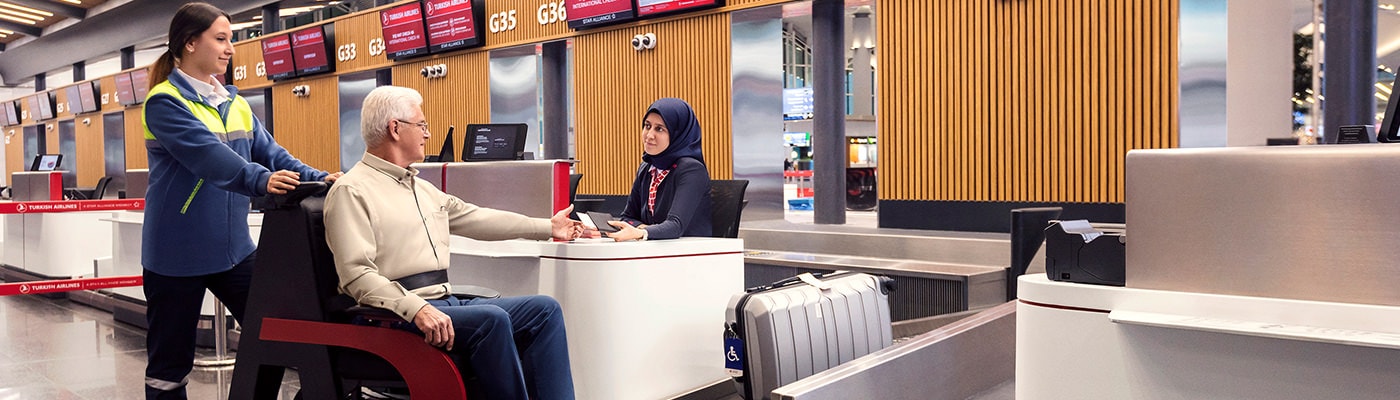
Disabled passenger and staff assisting them at the counter

我們為身障或身疾旅客提供特殊服務

為確保身障或身疾旅客可以舒適無憂地旅行,土耳其航空為有特殊需求的乘客提供特惠服務,包括身殘旅客折扣。 您可以在影片獲知我們為旅客的舒適及安全所採取的措施。
影片

輪椅服務請求必須在預定航班時間前至少 48 小時提交,並在預訂中確認。 雖然可能會根據資源可用性,考慮在 48 小時內提交請求,但不一定能夠滿足此類請求。 為確保及時完成行李處理、輪椅協助以及機場安檢程序,我們建議患病或身障的乘客,無論是否已完成線上報到手續,皆應分別在國內航班與國際航班起飛前至少兩小時和三小時到達航廈。

需要使用擔架出行的患者必須有同伴陪同;請注意,同伴的機票單獨開立。 此外,乘客/同伴必須提供土耳其文和英文報告,確認其狀況適合飛行。 該報告必須在開立之日起 10 天內呈交。 對於獲準使用擔架旅行的乘客,將按照公司確定的票價簽發機票。 獲準攜帶擔架旅行的乘客必須在航班起飛前 48 小時透過預先通知提交請求。

我們透過視訊通話中心,為聽障乘客提供手語服務。 如需了解詳細資訊、提交申請,請點選此處。

在伊斯坦堡機場,身心障礙或行動不便的旅客,可前往下列櫃檯,輕鬆辦理報到手續:


  • 國際航班適用:G40、G41、G42 和 G43
  • 國內航班適用:D17、D18、D19、D20、D21 和 D22

Is your health condition suitable for air travel? Learn more

If you have any concerns regarding your health before your flight, we strongly recommend consulting a doctor to ensure your journey is safe and comfortable. Most medical conditions do not prevent air travel; however, additional evaluations may be required in certain cases.

Passengers who have medical conditions that could be exacerbated or adversely affected by flying may be required to provide a doctor’s note stating that they “can complete the flight without needing urgent medical assistance.”

Passengers who require a medical certificate Learn more

  • Passengers with medical conditions that pose a potential risk to flight safety (such as active vomiting, severe shortness of breath, uncontrolled rapid breathing accompanied by shortness of breath, extreme pallor and cold sweats accompanied by weakness severe enough to prevent standing, a severely pained facial expression due to any cause, suspected confusion, uncontrolled agitation with sudden and unpredictable movements that could harm others, active bleeding or injuries that may indicate recent trauma, etc.),
  • Passengers who have undergone any type of heart, vascular, chest, or brain disease or related surgeries (bypass, angiography, heart surgery, brain surgery, etc.) within 10 (ten) days of the flight departure; or who have undergone orthopedic or major abdominal surgeries and wish to submit a statement regarding their condition or have a special request,
  • Passengers who require the use of medical devices (oxygen tanks, portable respiratory devices) during the flight.

Passengers unfit to fly due to medical conditions Learn more

Passengers with disabilities or health issues are accepted for travel unless they fall into one of the following categories, or unless the airline’s procedures specify otherwise.

  • Infants less than 48 hours old are not accepted for travel.
  • Pregnant passengers are not accepted for travel starting from the beginning of the 36th week of a single pregnancy or the beginning of the 32nd week of a multiple pregnancy.
  • Passengers who require the use of electric or air-pressurized equipment during the flight—other than oxygen cylinders provided by the airline and medical devices approved by the airline—are not accepted for travel.
  • Passengers who are determined to be unable to follow the cabin crew’s instructions in the event of an inflight emergency (for example, a passenger who cannot understand or follow instructions provided during the check-in process at the counter) will not be permitted to board the flight unless accompanied by a companion. If accompanied by a companion, they will be permitted to board the flight without a doctor’s note.
  • Passengers who have medical certificates stating that they require personal care or nursing services during the flight will not be permitted to board the flight unless accompanied by a qualified personal care assistant and/or nurse.
  • Passengers who have medical certificates or declarations indicating contagious and communicable diseases such as rubella, measles, mumps, meningitis, hand-foot-and-mouth disease, whooping cough, scabies, chickenpox, monkeypox, or tuberculosis will not be permitted to board the flight under any circumstances during the contagious period. However, these passengers may be permitted to board if they present a doctor’s note stating, “There is no risk of the disease spreading to other passengers.”
  • Passengers who, due to their physical or medical condition, are deemed to pose a direct threat to the health or safety of other passengers and/or their belongings, to the aircraft, or to the crew will not be permitted to board. (This includes aggressive or uncontrollable behavior, hallucinations or delusions, a tendency to harm oneself or others, extreme agitation). Such passengers will not be permitted to board the aircraft under any condition or circumstance, even if accompanied by a companion.

Passengers who must travel with an attendant/companion Learn more

To ensure that they can safely complete their journey and follow safety instructions in an emergency, some passengers may need to fly with an attendant.

Whether a passenger requires an attendant can be assessed based on their ability to provide consistent and context-appropriate answers to questions, follow instructions, and independently complete check-in procedures.

In addition, if the passenger’s medical certificate or evaluation indicates the need for an attendant, the passenger is permitted to board only if accompanied by their attendant. For passengers who have medical conditions that require being accompanied on the flight by a healthcare professional (such as a doctor, paramedic, or nurse, as specified in the report) during the flight, that person must meet the criteria below.

  • The attendant must be present with the passenger throughout the entire flight, including takeoff, flight, and landing,
  • The attendant is expected to have the physical and cognitive abilities necessary to assist the passenger in an emergency.

Cabin crew members do not provide companion services for passengers.

Passengers with Neurodevelopmental Diversity Learn more

Passengers with neurodevelopmental diversity (e.g., autism, ADHD (attention-deficit/hyperactivity disorder), intellectual or learning disabilities) are not required to provide a medical certificate; however, if these passengers require additional support in understanding safety instructions, responding appropriately to emergencies, or managing sensory challenges, they must travel with a companion.

Individuals in these situations may exhibit different behaviors—such as impulsivity, inattention, or an inability to sit still for long periods—due to social communication differences or stresses triggered by factors like light, sound, smell, crowds, or changes in environment. Passengers should not be asked questions regarding illness, medical diagnoses, etc., and they are not required to present a medical certificate.

However, if these passengers are traveling without a companion, their facility to understand safety instructions, to respond appropriately to emergencies, and/or to manage sensory difficulties can be assessed during the check-in process as follows:

  • Providing consistent and context-appropriate answers to questions,
  • Being able to follow instructions,
  • Being open to guidance,
  • Remaining calm amid noise, waiting, or crowds,
  • If the passenger can complete the check-in process independently, they will be accepted for the flight without an escort; except in cases that pose a serious threat to flight safety, the passenger will be permitted to board the flight.

Passengers reporting an allergy Learn more

  • We cannot guarantee that other passengers will not bring food or other items that may contain allergens into the cabin and/or consume such items during the flight.
  • Due to the cabin ventilation system, it is not possible to completely prevent food-derived particles from spreading throughout the aircraft.
  • It is not possible to completely eliminate all types of allergens from the aircraft cabin.
  • Passengers must consult their physician regarding their fitness to fly under these conditions.
  • Passengers must carry their own medication (e.g., an epinephrine auto-injector, etc.) along with the medication prescription.
  • Passengers are responsible for taking the necessary personal precautions during the flight.
  • Passengers at risk of a severe allergic reaction must travel with a companion who can assist with administering medication in an emergency.
  • Passengers are solely responsible for any health issues that may arise during the flight.

Should you travel alone or with a companion? Learn more

Passengers with disabilities or reduced mobility can travel alone if they are able to meet their personal needs independently.

Passengers who are unable to understand safety instructions, respond appropriately to emergencies, manage sensory challenges, or meet their personal needs independently are required to travel with a companion.

Medical certificate requirements

To ensure that passengers who require a medical clearance can travel safely and comfortably on our flights, a medical certificate must be presented. The medical certificate, prepared in Turkish or English, must be completed by a doctor, must be dated within 10 days of the flight departure, and must include a written statement confirming that the passenger can complete the flight without needing urgent medical assistance.

The medical certificate must also include the doctor’s first and last name, title, license number, wet signature or e-signature, and the date of issue.

輪椅服務


Disabled passenger in a wheelchair and staff assisting them at the airport

申請輪椅的乘客可享受免費輪椅服務。 輪椅申請必須在航班起飛前至少 48 小時提交。 其他輪椅申請在車站設施內進行評估。

提供的優先順序


Window seat on the aircraft

必要時為有特殊需要的乘客優先辦理登機手續、通過護照檢查和登機。 依據座位供應情況和飛機配置為有特殊需求的乘客提供前排座位。

導盲犬


導盲犬可免費進入客艙。 為情緒支持犬和導盲犬提供預訂須至少在出發前 48 小時提交。 在飛行過程中,導盲犬必須坐在主人的腳下,不需籠子。

導盲犬必須持有有效的健康證明、身份證件和疫苗接種文件。 此外,導盲犬必須持有目的地國家要求的所有其他文件。 機場報到時可能會要求提供這些文件。

如需更多資訊,請參閱我們的寵物旅行頁面

向日葵徽章套掛服務


Sunflower lanyard

例如自閉症、癡呆症 (健忘症)、焦慮症、言語困難、閱讀困難及視力困難,這類經由觀察但難以發現的差異,可能會導致旅客旅行以及在機場和飛行時遇到困難。

為了盡量減少乘客在旅途中可能遇到困難,我們開始提供向日葵套掛服務。

地勤及機組人員看到乘客佩戴向日葵徽章套掛,會意識到佩戴徽章的乘客在部分過程可能需要更多幫助、支援或更多時間。

乘客可以在我們位於伊斯坦堡機場的輔助出境報到櫃檯免費獲得徽章掛套,無需證明其狀況,並可在整個旅行期間獲得服務。 此外,乘客可以在後續的行程以及在提供向日葵徽章掛套的服務點繼續使用同一張卡。

醫療器材


Medical equipment icon

客艙提供飛行期間您可能需要的一些醫療器材。 您也可以在飛行期間使用自己的醫療器材。

氧氣瓶


Oxygen cylinder icon

基於安全因素,在飛行過程中不得使用自己的氧氣罐;但我們會根據診斷證書提供氧氣罐,根據醫療報告中的說明提供每分鐘用量。 氧氣查詢應至少在飛行前 48 小時進行。

呼吸器


Respiratory device icon

如果您攜帶個人呼吸器/POC/CPAP 機器旅行,請確保該設備已獲得 FAA 批准。您可以在需要時使用自己的裝置,起飛和降落期間除外。 攜帶便攜式呼吸器旅行的乘客必須在航班起飛前 48 小時告知預訂部門有關該設備的運輸和/或使用資訊。 如果旅客打算在客艙內使用攜帶式呼吸器,則需提供醫生證明。 請務必確認,如果您預計在機上使用呼吸器,則應攜帶足夠的電池(足以維持 1.5 倍飛行時間)。機艙非義務提供此裝置電源插座。

藥物


Medication icon

罹患糖尿病的乘客可以服用糖尿病的相關藥物而無需出示報告。 飛行期間,罹患除糖尿病外其它疾病且需要服藥的乘客必須隨身攜帶處方。

美國航班資訊 了解更多

投訴解決人員 (CRO)

在往返美國的航班上,乘客可以要求就任何與殘障有關的問題與投訴解決人員 (CRO) 交談。CRO 團隊有權代表土耳其航空公司解決投訴問題。CRO 團隊成員接受了“美國交通部,第 14 篇,第二章,D 子章,328 部分,K 子部分”中規定的敏感性和覺知訓練,以及相關的 DOT 法規和立法培訓。機場在營運時間內提供 CRO 服務。如果無法聯絡 CRO,則可以傳送電子郵件至 CRO@THY.COM,您的問題會得到必要的關注。請查看此頁面,了解 CRO 完整清單。CRO 服務提供英語和土耳其語版本。

如果您認為土耳其航空公司違反了聯邦法規 14CFR 第 382 部分的任何規定,請透過以下管道根據 14CFR 第 382.65 部分的適用程序提出正式投訴:

透過郵件:

U.S. Department of Transportation Aviation

Consumer Protection Division/C-75400

7th Street, SW

Washington, D.C. 20590

1-202-366-2220

透過線上管道:

航空消費者保護部門 深入瞭解 >>

航空消費者保護部門 >>

航空無障礙法案 (ACAA)

您可以查看美國交通部最終條例標題 14第 2 章第 382 部中的文章 "Non-discrimination on the Basis of Disability in Air Travel(身心障礙者搭機反歧視準則)"。

可以透過以下管道了解交通部的規定。

殘障乘客的免費電話號碼 - 英語:

1-800-778-4838(語音)

1-800-455-9880 (TTY)

美國航空消費者保護部門的電話號碼:

202-366-2220(語音)

202-366-0511 (TTY)

美國航空消費者保護部門地址:

C-75,美國運輸部

1200 New Jersey Ave., SE

Washington, D.C. 20590

美國航空消費者保護網站:

http://www.dot.gov/airconsumer